
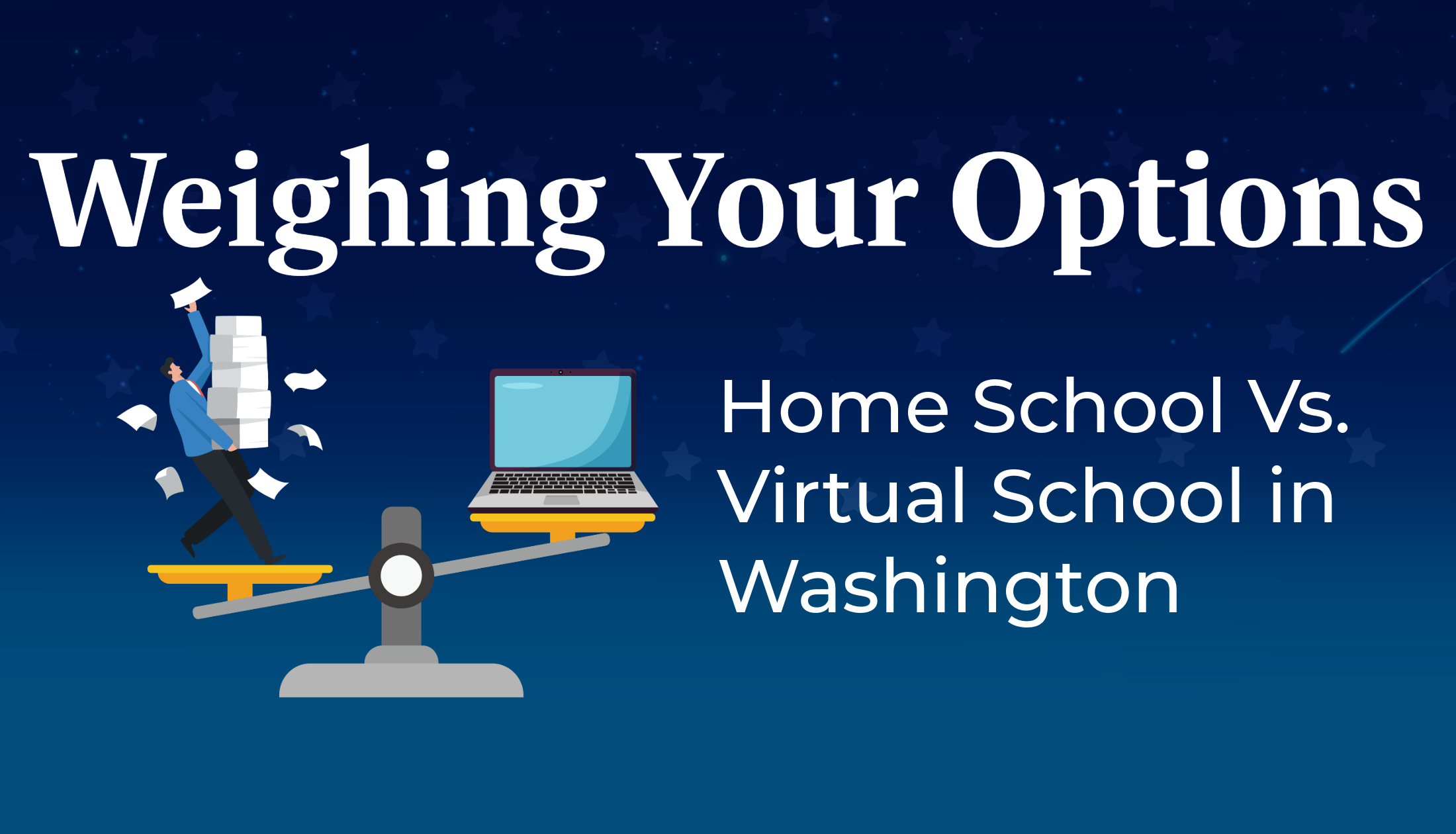
Choosing the right educational path for your child is one of the most important decisions a family can make. In Washington, many families exploring alternatives to a traditional classroom land on two options: homeschooling and virtual school. Both let students learn from home. Both offer flexibility. And both give families more say over their child's learning environment.
But they're not the same thing, and the difference is more significant than you might assume. Homeschooling can be a rewarding, deeply personal experience, but Washington law places specific responsibilities on the parent. Virtual school offers many of the same at-home benefits while sharing that load with certified teachers, a structured curriculum, and built-in academic support.
What Does Washington Law Actually Require of Homeschooling Parents?

Washington's Home-Based Instruction Law places several specific legal obligations on parents, covering everything from qualifications to required subjects to annual testing. Understanding these requirements is the clearest way to see what homeschooling really involves day to day — and where virtual school takes a different approach.
According to the Washington Homeschool Organization, Washington's compulsory attendance law applies to children age 8 and older, and home-based instruction falls under a specific set of state requirements:
Parent qualifications: To legally homeschool, a parent must meet one of several requirements: earning 45 quarter units of college-level credit, completing a parent qualifying course, working with a certificated teacher who meets with the student roughly an hour a week, or being deemed sufficiently qualified by the local school district superintendent.
Required paperwork: Families must file an annual Declaration of Intent to Provide Home-Based Instruction with their local school district, listing the child's name and age, the parent's name and address, and how the parent is qualifying to teach.
Required subjects: Washington law specifies 11 subject areas that must be part of a homeschool curriculum: reading, writing, spelling, language, math, science, social studies, history, health, occupational education, and art and music appreciation. These don't need to be taught as separate classes — a single unit study can touch several at once — but all 11 need to be covered.
Annual testing: Students must be assessed each year, either through a non-test assessment written by a certified teacher, or a standardized achievement test approved by the State Board of Education.
Recordkeeping: Parents must maintain records of test scores or assessments, immunization records, and other materials related to instruction — records that stay private, but that a future school may request if the student later enrolls elsewhere.
None of this makes homeschooling a bad choice, as plenty of Washington families do it well. But it does mean the entire weight of curriculum planning, instruction, grading, and legal compliance sits with the parent. Virtual school offers a way to share that weight.
What Is Virtual School, and How Is It Different?
Virtual schools deliver education through online learning platforms, but unlike homeschooling, students remain enrolled in an accredited school with certified teachers and a structured curriculum. The day-to-day experience can look similar, but who's responsible for what looks very different underneath.
Unlike homeschooling, virtual school students benefit from:
Certified teachers who lead instruction rather than a parent teaching every subject
A structured curriculum aligned with state academic standards, already built and paced
Official grading, transcripts, and report cards issued by an accredited school
Academic counseling and support services built directly into the program
For many families, that combination is the real draw: the flexibility of learning from home, without giving up the structure and support of a traditional school.

Who Provides Instruction — You or a Certified Teacher?
In virtual school, licensed teachers deliver instruction in every subject, while parents take on a supporting "learning coach" role rather than becoming the primary teacher. That distinction becomes especially important as coursework gets harder.
In a homeschool environment, parents are responsible for teaching every subject themselves. Many do this well, but teaching multiple subjects across grade levels gets genuinely difficult once a student reaches advanced material like algebra, chemistry, literary analysis. Virtual school removes that pressure. Students still have an involved parent at home, but the actual instruction comes from:
Licensed teachers who specialize in their subject area
Lessons built by curriculum specialists, not assembled from scratch by a parent
Detailed feedback on assignments and assessments
Teachers who already know the state academic standards inside and out
Does Virtual School Follow a Structured Curriculum?
Yes, virtual schools provide a complete, standards-aligned curriculum, while homeschooling families are generally responsible for researching, selecting, and assembling their own materials. That difference alone can save families a significant amount of time and guesswork.
Homeschooling under Washington's law still requires covering all 11 mandated subjects, and finding materials that fit each one — while making sure they add up to a genuinely sufficient education — is real work. Virtual school simplifies this considerably, with course materials, lesson plans, pacing, assessments, and a clear academic pathway from elementary school through graduation already built in.
Who Handles Records, Transcripts, and Diplomas?

Virtual schools manage all official academic records, including report cards, transcripts, and accredited diplomas — responsibilities that fall entirely on parents in a homeschool setting. For families thinking ahead to college applications, this can be one of the more meaningful differences.
Under Washington's homeschool law, parents are responsible for keeping their own records: test scores or assessments, immunization records, and materials related to instruction. These records stay private, but a student later enrolling in a traditional school, or applying to college, may need to produce them. Homeschool diplomas are valid, but colleges and employers sometimes request additional documentation to verify a student's academic history. Virtual school removes that extra step, since transcripts and diplomas come directly from an accredited institution.
What Academic Support Comes Built In?
Virtual schools typically include academic support services, like tutoring, counseling, and specialized help, as part of the program itself, rather than something a family has to seek out separately. That built-in layer of support is one of the more practical, everyday advantages.
In a homeschool environment, families often need to find outside tutoring, counseling, or specialized learning support on their own — which takes both time and money. Virtual school programs frequently provide:
Teacher office hours and tutoring sessions
Academic advisors and counselors
Special education services when applicable
College and career readiness guidance
Having a team of educators already in place can make a real difference for a student who's struggling with a particular subject or skill.
How Do Students Stay Socially Connected?
For families weighing socialization concerns, this structural difference is worth knowing about. Virtual schools often build social interaction directly into the academic experience, through live classes, group projects, clubs, and school events — rather than leaving families to organize it separately.

Homeschool families frequently build community through local homeschool groups, co-ops, or community organizations — valuable, but something parents have to coordinate themselves. Virtual schools tend to fold this into the program:
Live online classes where students interact directly with peers
Collaborative group projects
Student clubs and extracurricular programs
Virtual and in-person school events
How Much Work Does Virtual School Require for Parents?
Homeschooling parents manage nearly every aspect of their child's education — lesson planning, teaching, grading, compliance, and transcripts — while virtual school shares that responsibility with certified educators. For families balancing work, multiple children, or other demands, that difference can be significant.
Virtual school allows parents to stay closely involved in their child's education without carrying the full administrative and instructional load themselves. It's a partnership rather than a solo effort.
Flexibility Without Sacrificing Structure
Virtual school offers much of the same flexibility families are drawn to in homeschooling, while adding structure and accountability that can be harder to build alone. Students still learn at home and can work at a pace that fits them, but with guardrails already in place.
That balance shows up in a few concrete ways:
Clear learning goals and course expectations set by the school, not assembled from scratch
Ongoing teacher guidance and instruction throughout each course
Regular feedback and progress monitoring, so problems get caught early
A defined academic pathway that leads all the way to graduation
Preparing Students for College and Career
Because virtual schools operate within accredited educational systems, they often provide direct support for what comes after graduation. That’s something homeschool families typically have to research and coordinate on their own. At WAVS, this includes:
College and Career planning with our Success Specialists
Career exploration through CTE Pathways
Dual Credit trade and college credits
Structured practice in digital literacy and independent learning. These skills carry directly into college and the modern workplace
Frequently Asked Questions
Is virtual school the same as homeschooling?
No. Homeschooling is parent-directed education, governed by Washington's Home-Based Instruction Law, where the parent manages instruction, curriculum, and compliance independently. Virtual school students are enrolled in an accredited school and receive instruction from certified teachers.
Do parents need to teach their child in virtual school?
Not in the way homeschooling requires. Parents act as learning supporters, helping with routines, motivation, and organization, while certified teachers handle instruction and grading.
Do virtual school students receive an official diploma?
Yes. Students enrolled in an accredited virtual school receive an official diploma and transcript, recognized by colleges and employers.
What are Washington's actual legal requirements for homeschooling?
Parents must meet one of several qualification paths, file an annual Declaration of Intent, cover 11 required subjects, complete annual testing, and maintain their own academic records, per the Washington Homeschool Organization.
Is virtual school recognized by colleges?
Yes. Accredited virtual schools provide official transcripts and diplomas that colleges and universities recognize during admissions.
Is virtual school a good option for working families?
Often, yes. Since certified teachers handle instruction and grading, working parents can stay engaged and supportive without having to serve as the primary instructor for every subject.
The Bottom Line
Learning from home has become an increasingly popular choice for Washington families seeking flexibility and a more personalized environment. Homeschooling offers real independence, but it also places significant, legally defined responsibility on parents — qualifications to meet, subjects to cover, records to keep, and testing to arrange every year.
Virtual school offers a different path to many of the same goals. By combining the comfort of learning at home with certified teachers, a structured curriculum, and built-in support, virtual school creates a partnership between families and educators — one that can make the day-to-day experience more manageable without giving up the flexibility that drew families to home-based learning in the first place.
Curious whether virtual school is the right fit? RSVP for our Meet your School Event!
Follow us for more updates all year long: Facebook | Instagram | TikTok

Sources
Washington Homeschool Organization, Homeschool Law. washhomeschool.org
