Can Virtual School Still Feel Social? Principal Ryan Shares How WAVS Builds Community
As a dad raising two boys while navigating a career in education, I completely understand why parents hesitate when considering an online school like Washington Virtual Schools (WAVS). The immediate question is almost always: "But what about socialization?"It's a completely valid worry. No parent wants their child to miss out on the friendships, peer support, and shared memories that make the school years meaningful.
Before I saw a high-functioning digital school community in action, I had those same questions myself. I pictured my own kids sitting alone in front of a screen, and it didn't sit right with me. But what I've learned — both as a principal and as a parent — is that we need to look closely at what "socialization" actually means inside a traditional building. Often, it amounts to passing waves between classes, sitting quietly through a lunch period, or navigating the chaotic social pressures of a crowded hallway. Proximity isn't the same thing as connection.
At WAVS, we don't leave connection to chance or a random seating chart. We build community with absolute intentionality — connecting students through shared passions, curated group discussions, and cooperative goals. That's a promise I make to every family who walks through our virtual doors, because it's the same promise I'd want kept for my own sons.
So, Does Online School Actually Offer Socialization?
This is the question I get asked most often, so let me answer it directly: yes — but it looks different, and for many students, it's actually more meaningful.
In a traditional school, social interaction is largely passive. Kids are placed in a room together and expected to figure out the rest on their own. At WAVS, social interaction is designed. Every club, homeroom, and group project exists because we built it to give students a genuine reason to connect — not because a bell rang and everyone happened to be in the same hallway.
That distinction matters enormously, especially for the students and families who come to us specifically because a traditional classroom wasn't working socially — kids who were bullied, who felt invisible in a class of thirty, or who simply process the world differently and need connection on their own terms. For many of these families, WAVS isn't a step away from community. It's the first time their child has actually found one.
The Evidence: The Blueprint of Digital Connection
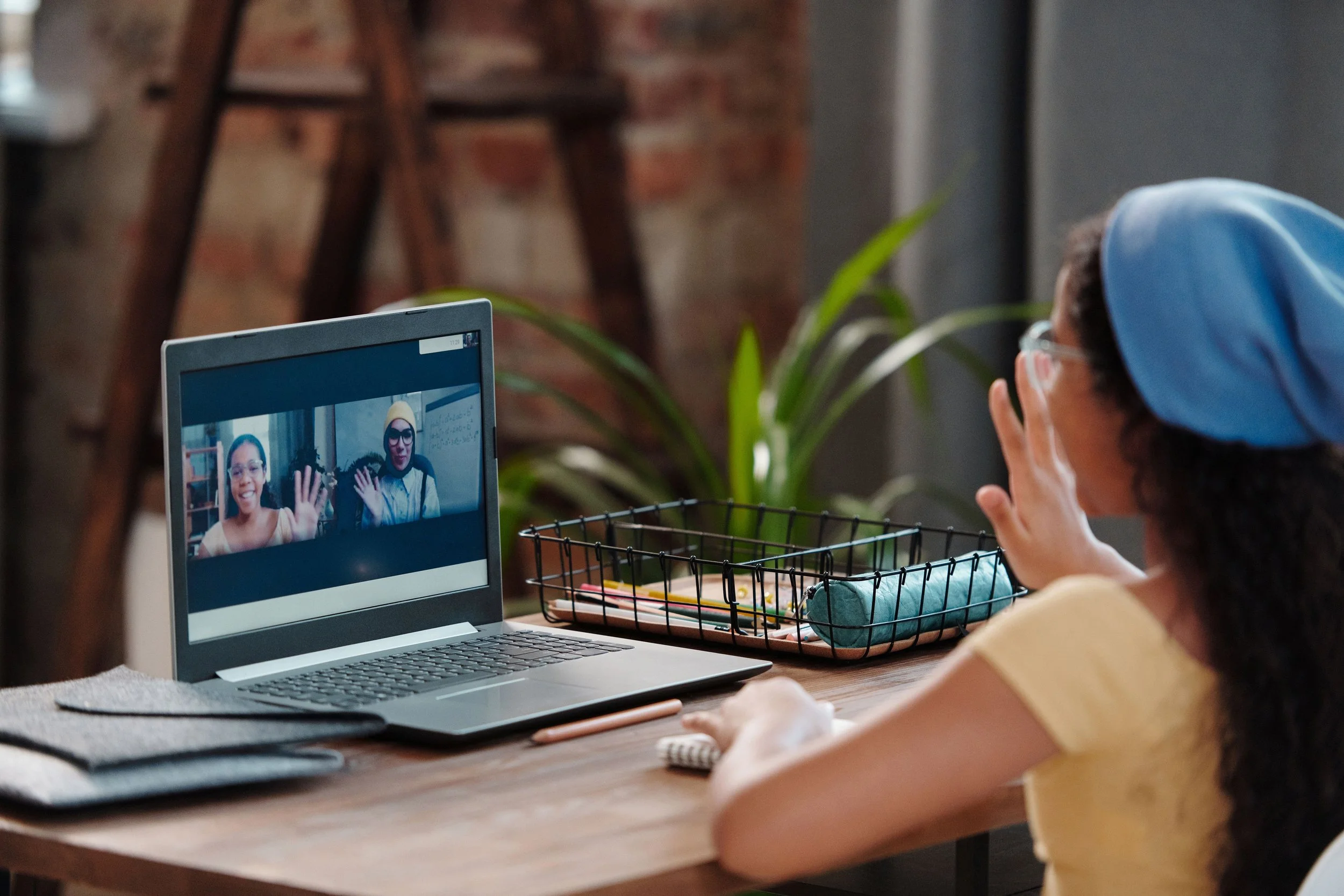
Building a true community across physical distances requires a thoughtful mix of storytelling and structural design. I often tell my staff to think about our school community the way a great public radio feature is built: you highlight individual student journeys — a kid who found their voice in a virtual debate club, a teen managing a chronic illness who can now attend class without missing a beat — to build collective empathy and understanding across our entire student body. When students see themselves and their peers reflected in real stories, connection follows naturally.
This isn't just a hunch. Academic research on virtual learning environments shows that when students feel safe and unburdened by the immediate social anxieties of a physical building, they are actually more likely to speak up in digital forums, collaborate authentically on group projects, and share their unique perspectives without fear of judgment. Removing the pressure of "who's watching me in the hallway" often opens kids up rather than shutting them down. I've watched painfully shy students become confident, active voices in a Zoom homeroom in ways I never saw them manage in a physical classroom during my years teaching in traditional buildings.
What Community Actually Looks Like at WAVS, Week to Week
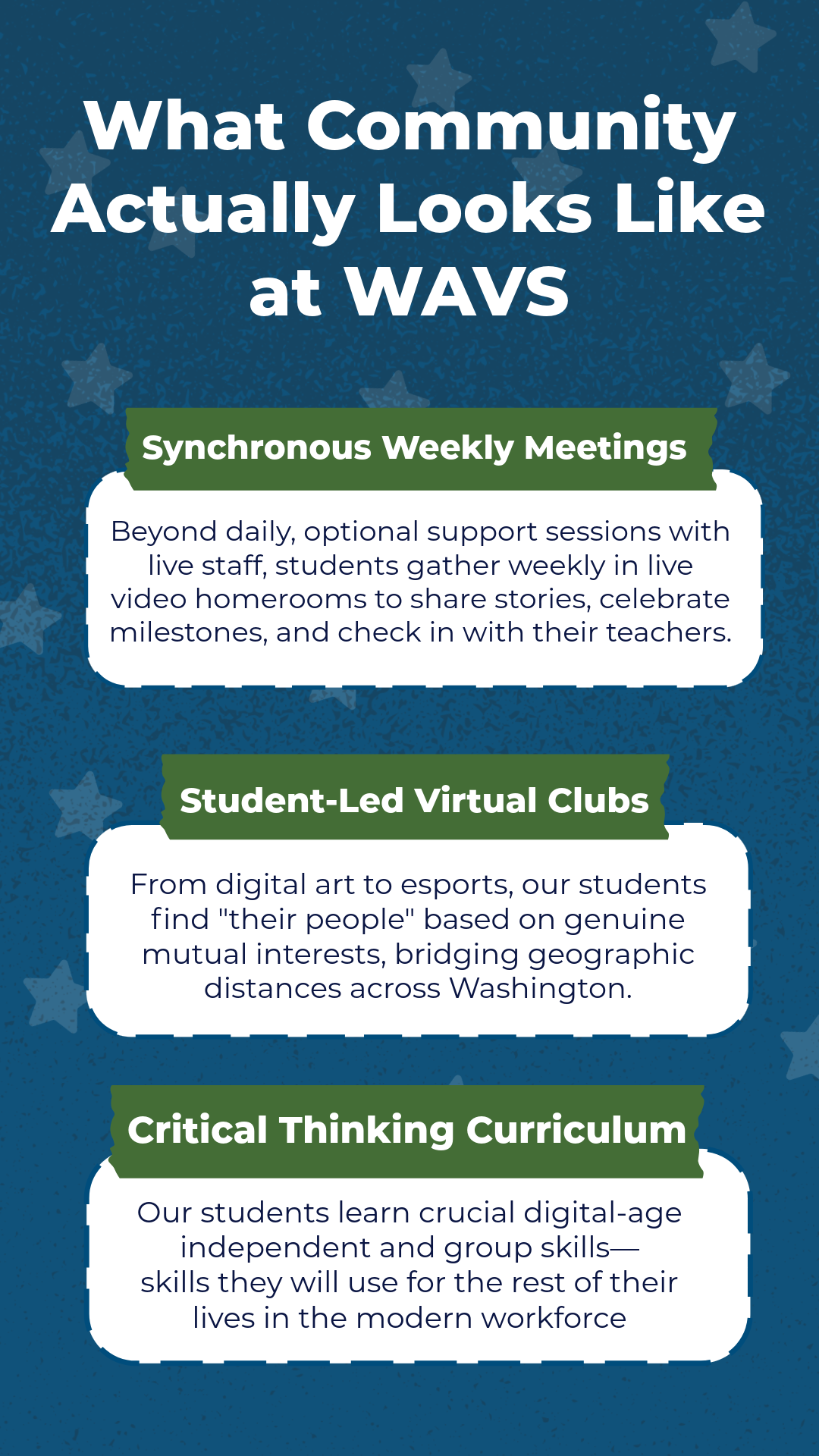
Community at WAVS isn't an abstract theory or a line in a brochure — it's an active, daily practice. Here's a glimpse of what it looks like on any given week for our students:
Synchronous Weekly Meetings: Beyond daily, optional support sessions with live staff, students gather weekly in live video homerooms to share stories, celebrate milestones, and check in with their teachers. They're the digital equivalent of homeroom banter, and often the highlight of a student's week.
Student-Led Virtual Clubs: From digital art to esports to book clubs, our students find "their people" based on genuine mutual interests, bridging geographic distances across Washington state. A student in rural Eastern Washington can be teammates with a student on the coast — something a neighborhood school could never offer.
Critical Thinking Curriculum: Our curriculum relies heavily on interactive, discussion-based learning where students build crucial digital-age independent and group skills — skills they will use for the rest of their lives in the modern workforce, where remote collaboration is often the norm, not the exception.
A Principal's View: Why I Believe in This Model
I won't pretend virtual school is the right fit for every family — no school is. But I will say this: as a principal, I've had more one-on-one, meaningful conversations with WAVS students than I ever did managing hallway traffic in a traditional building. I know our students' names, their interests, and often their stories, because our model is built around knowing kids as individuals rather than managing them as a crowd.
As a parent, that's exactly what I want for my own boys — a school where an adult actually knows who they are. That's the standard I hold WAVS to every single day.
FAQ: Socialization
Does my child need to be on camera to participate socially?
Live video homerooms and clubs are a core part of our community-building, but we also offer multiple ways to engage — discussion boards, group chats, and collaborative projects — so students who are camera-shy at first still have a real path into the community.
Will my child make lasting friendships in a virtual school?
Yes. Many WAVS students describe their club friends and homeroom peers as some of their closest friendships — relationships built on shared interests rather than assigned seating.
Is virtual school socialization backed by research, or is this just a talking point?
It's backed by research. Studies on virtual learning environments consistently show that reduced social anxiety in digital spaces can increase student participation, authentic collaboration, and willingness to share ideas — outcomes that support both academic and social growth.
Who is WAVS a good fit for?
WAVS tends to be an especially strong fit for students who struggled socially in a traditional classroom — due to bullying, anxiety, health needs, or simply feeling lost in a large student body — as well as families seeking more flexibility and a tighter-knit school community.
Ready to Explore WAVS?
Transitioning to a virtual school is a major step for a family, but you don't have to navigate it alone. I'd love to connect with you personally. Join us for our upcoming Meet your School Event to tour our platforms, meet our dedicated faculty, and ask your questions live — parent to parent, and principal to family.