
Principal Ryan Builds Virtual Learning With Human Connection
As the school year creeps closer once again, we’re excited to welcome students – new and returning – to thrive in our WAVS community.
Community is even more important in virtual school: without the casual interactions built into traditional schools, virtual connections must be developed with more purpose than most are used to. Luckily, we have a leader guiding our school who understands how vital relationships are to helping online students succeed.
Let’s get to know Principal Jeremy Ryan, and how he approaches human connection in virtual learning.
Why I Chose Education (And Why Virtual is the Next Frontier)
“When I started my journey in education nearly twenty years ago, my commitment was driven by a fundamental question: how do we design learning environments where every single student can thrive?
Over two decades as a teacher and school administrator—with professional licenses across Washington, California, and Colorado—I have worked with diverse student populations in subjects including history, elementary education, physical education, and special education. Those distinct vantage points taught me that the traditional brick-and-mortar classroom is just one framework for learning, and it isn't always the perfect fit for every child's unique rhythm.
When people hear the term ‘virtual school,’ a common misconception is that a student is isolated behind a screen, clicking passively through automated modules. That couldn't be further from the truth. I chose to lead in the virtual space because it allows us to strip away the rigid constraints of a physical building and replace them with intentional, flexible, and equitable structures. We aren't removing the human element from education; we are removing the traditional roadblocks to it.”
Bringing the Story to Life
“In a standard physical classroom, a student who is struggling or anxious can easily fly under the radar in a crowded room. In a virtual environment—when built with intent—every single interaction is purposeful.The true power of virtual learning lies in precision and deliberate curriculum design.
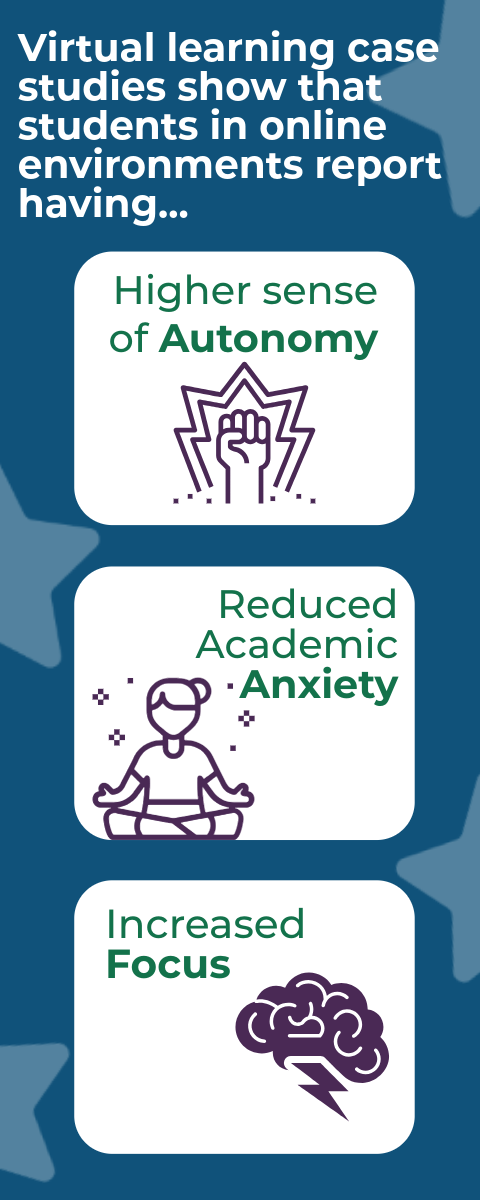
Data across virtual learning case studies shows that students in flexible, online environments report a significantly higher sense of autonomy over their learning schedules. This directly correlates with reduced academic anxiety and increased focus. By leveraging modern digital tools, our faculty doesn't just broadcast lessons; we track real-time comprehension and step in with targeted support exactly when and where a student needs it.”
Virtual School and Connection: What the Data Says
And Principal Ryan hits the nail on the head: when virtual students feel connected to the people supporting their education they succeed. The data doesn’t lie.
According to an article in the National Library of Medicine, “Feeling connected increases the likelihood of student health and wellbeing (Arslan, 2021), academic success (Wilson, 2018), and graduate prospects (Bridgstock et al., 2019). Hence, it can be inferred that feeling connected is an essential component of the student experience [...] ” (Hehir et. al)
Another article from the CCRC blog follows the first-hand advice given by a virtual university student, highlighting their personal experience: “Students want to respond meaningfully to their peers and instructors [..] They want that opportunity to see what other students are interested in and how they understand the concepts they are learning in class” (Thompson).
So, now we know that Principal Ryan is right – connection is a vital foundation on which to build a virtual school. How do we, and by extension virtual schools, build that foundation?
Luckily, those same sources point us in a direction that WAVS is already heading in. Hehir points to “Usability, teacher presence, immediacy, synchronicity, and community [as] the five components identified as being essential to encourage student feelings of connectedness” (Hehir et. al). If that sounds a bit too vague, Thompson breaks it down in language that’s a bit easier to understand:
“Instructors should use peer engagement activities (such as group assignments, study groups, and yes, even discussion boards) to create space for students to explore their confusion and teach one another, all while fostering some personal connections” (Thompson).

In summary, building community in online school requires:
Technology that works
Proactive and invested teachers
Quick, relevant feedback
Synchronous class time
Intentional course design
It sounds simple enough – and, with Principal Ryan’s help, it is that simple at WAVS.
Why We Do What We Do
Let's take a look at how our approach fits in with the roadmap to connectedness we just set out.
Technology that works: From providing computers to students in need, to our tech support, to our BrightThinker curriculum, we’re always thinking about how to make technology accessible to families.
Caring teachers: WAVS would be nothing without our educators. That’s why we focus on hiring certified teachers and counselors who are local to Washington.
Useful feedback: In a class of 30, it can take a while for teachers to turn around detailed feedback. But, in a virtual school, the teacher to student ratio allows for faster feedback without sacrificing detail.
Synchronous class time: While we are fully virtual, our teachers host optional synchronous classes daily, alongside one on one sessions. What we lack in face to face opportunities we make up for with intentional virtual class time to build connections and confidence.
Intentional course design: One of the hardest obstacles COVID posed to education was the swift transition to online learning without all the tools to properly support it. But with our BrightThinker curriculum and online tools, we approach virtual school with much more intentionality to ensure our students succeed.
Check, check, and check – we pass! Though virtual school won’t work for every student, we do our best to build a community around our students.

FAQ Section: What Parents Ask Me All the Time
"Will my child be staring at a laptop screen for eight hours straight?"
Principal Ryan: Absolutely not. Our model emphasizes balanced learning. While instructional delivery and community check-ins happen online, students frequently engage in independent project-based tasks, offline reading, and real-world application away from the screen.
"How do teachers keep track of my student’s progress if they aren't in a physical room?"
Principal Ryan: Because our systems log engagement and learning data dynamically, our educators actually have more immediate insight into learning gaps than a teacher grading papers at the end of a long week. We see where a student hesitates, where they excel, and how to pivot our instruction instantly.
"Is a virtual diploma held to the same standard as a traditional school?"
Principal Ryan: Yes. Washington Virtual Schools offers a fully accredited, robust curriculum that meets all state standards. Our students graduate completely equipped for college, careers, and whatever future path they choose.
Connect With Us
The first step in building a relationship is finding the right opportunity – luckily, we have just the thing! Check out our next Meet you School Event on Wednesday August 5th at 6pm. There, you can meet Principal Ryan yourself and take that first step.
RSVP here to make sure you secure a spot.
Can’t make it to this one? No worries! There will be more coming soon. In the meantime, make sure to follow our Instagram, Facebook, and TikTok accounts to know what events we have coming soon.
Sources
Hehir, Elizabeth, et al. "Developing Student Connectedness Under Remote Learning Using Digital Resources: A Systematic Review." Education and Information Technologies, vol. 26, no. 5, 2021, pp. 6531–6548. National Library of Medicine, doi:10.1007/s10639-021-10577-1.
Thompson, Akilah H. "Looking Beyond the Screen: Connection and Humanity in Online Learning Environments." CCRC Blog, Community College Research Center, Teachers College, Columbia University, 8 May 2025, ccrc.tc.columbia.edu/easyblog/looking-beyond-the-screen-connection-in-online-learning.html.
