
Back on Track: How to Catch Up in Virtual School Without Burning Out

Picture a Washington family with a virtual school student: let’s call her Nora. A string of Pacific storms rolls through, the power goes out for a few days, and with it goes the WiFi — no live Science session, no way to submit a project that happened to be due that week. By the time things are back up and running, a week of coursework has quietly piled up, not because Nora stopped trying, but because the storm didn't care what was due.
Nora isn't a real student. She's a composite, a way of putting a face on a pattern a lot of Washington Virtual families know. If a version of her story sounds familiar, this post is for you.
Almost every virtual school student falls behind at some point during the year. A rough week, a missed assignment that snowballs, a stretch where motivation disappears. Falling behind is not a sign of failure. It is a normal part of a long school year, and it is recoverable with the right plan.
Here's the kind of plan that helps a family like Nora's close the gap before it becomes a bigger problem, and how any Washington Virtual family can use the same five steps.
What Should I Do First When I'm Behind in Virtual School?
Pause and make a plan before diving back in. Trying to tackle everything at once usually leads to burnout, not progress, and a short pause to prioritize saves far more time than it costs. Message your teacher, list every missing assignment, and decide what matters most.
While falling behind can feel demoralizing, especially when you can’t physically flag down a teacher, it’s important to remember that waiting will only make it worse. Even taking a small step forward — completing a quiz you missed for partial points, drafting a message to your teacher or a classmate — is better than standing still.
How to Catch Up in Online School: A 5-Step Plan
Step 1: Message Your Teacher Before You Open the Coursework
Once the power is back on, it's tempting for a student in Nora's situation to just open the laptop and start catching up quietly. A better first move is a short message sent before anything else.
Don’t wait for a "good excuse" or until you feel less embarrassed. Teachers would much rather hear from a student early than find out after a grade has already dropped. (New to this? Here's how to reach your teachers.)
A short, honest message goes a long way: "I've fallen behind in this class and want to make a plan to catch up. Can we talk about my options?" That one message often opens doors you cannot see from the outside, like partial credit, revised deadlines, or extra support.
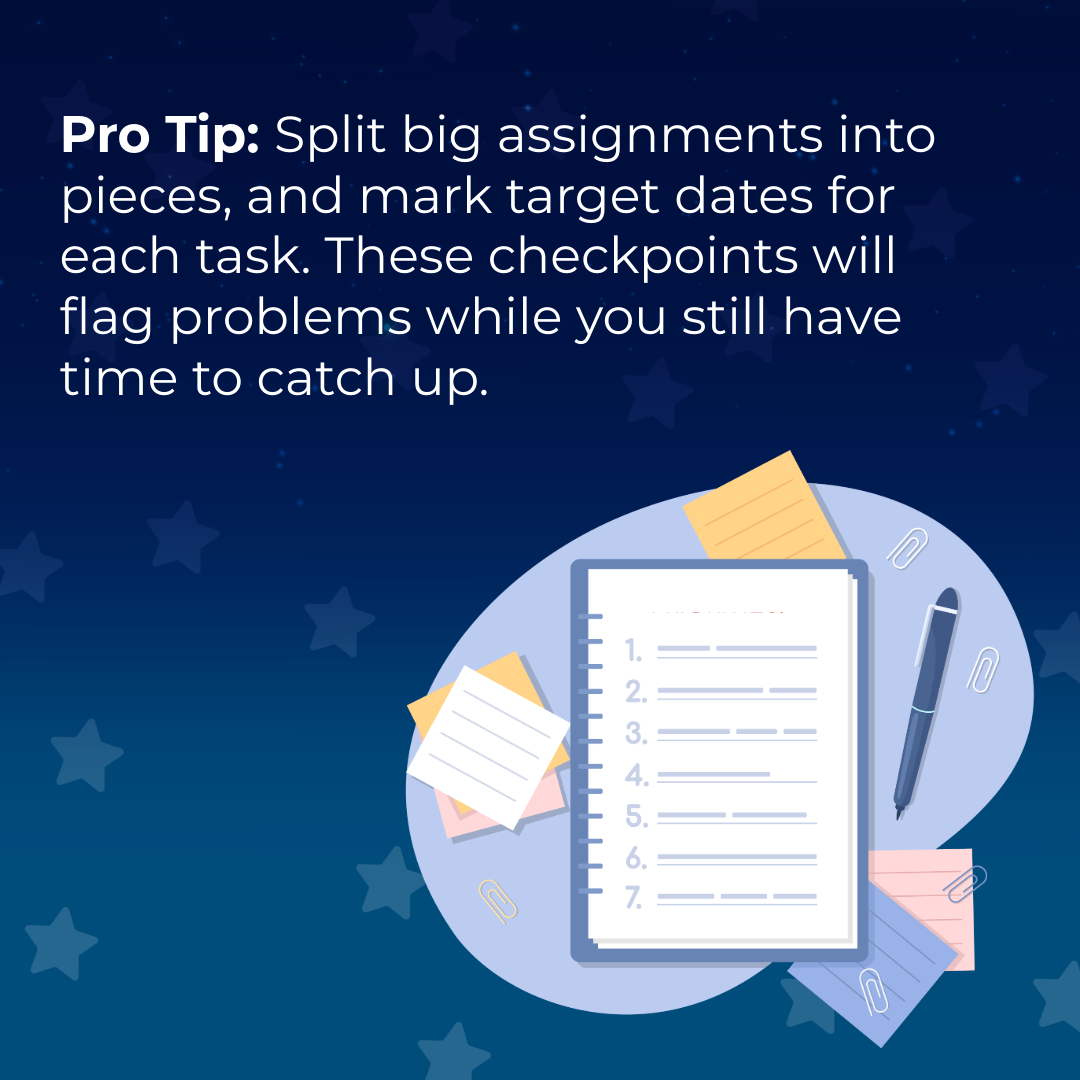
Step 2: Find and Prioritize Every Missing Assignment
Make a simple list of everything outstanding. For each item, note:
What is the task, and when was it due?
How much of the grade does it affect?
Is full or partial credit still possible?
Will catching up here actually move the needle?
A list like Nora's usually turns out shorter than the panic suggests: a project, a missed session, maybe a couple of reading check-ins. Written down instead of just looming, "a week gone" tends to look a lot more manageable. Especially when not every missing assignment deserves equal attention. The University of Washington's academic guide on catching up suggests asking a few honest questions:
Is the grade I need in this class still realistically achievable?
Is this course required for something specific, like a future class, a program, or graduation?
Will catching up here meaningfully change my overall standing, or is my energy better spent elsewhere?
This is not about giving up on anything. It is about putting limited time and energy where it does the most good.
Step 3: Build a Realistic Catch-Up Schedule
Once there is a list, it is tempting to picture yourself studying five hours a night. Resist that. An unrealistic plan just sets up a second round of falling behind.
Work backward from real deadlines to decide what happens each day
Break big assignments into smaller daily chunks
Plan around sleep, meals, and normal life, or the plan will not survive day two
Plan one day at a time, each evening, instead of mapping the whole month upfront
If your days need more shape overall, our guide to structuring your virtual school schedule is a good next read. Realistic, sustainable progress beats an ambitious plan that collapses by Wednesday.
Step 4: Protect Sleep, Meals, and Breaks
Sleep, meals, and movement are the first things students sacrifice during a catch-up push, and they are exactly what makes catching up possible. The CDC recommends 9 to 12 hours of sleep for school-age children and 8 to 10 for teens, and short sleep makes focus and follow-through harder the next day.
Keep a consistent sleep and wake time, even during a busy week
Do not skip meals to "save time." Low energy makes everything take longer
Take short breaks between work sessions instead of pushing for hours straight

Step 5: Find the Root Cause So It Doesn't Happen Again
This step gets skipped more than any other, and it is the one that prevents a repeat next month. Once the crunch is handled, ask honestly what led to falling behind:
When did I start feeling behind? What was happening around that time?
What am I feeling right now: tired, anxious, embarrassed, stuck?
If you could dump everything on your mind onto paper right now, what would you write?
Have I told anyone how I'm really doing, or have I been carrying this alone?
Has communication with the teacher broken down somewhere along the way?
For a student like Nora, the root cause is usually straightforward: no backup plan for a multi-day outage. Some families in this situation start downloading key lessons ahead of time each week and keeping a mobile hotspot charged, so the next storm becomes an inconvenience instead of a lost week.
Whatever the answer, naming the underlying problem allows you to find a solution: a time management system that fits how your student thinks, a new communication habit with teachers, or a small change to daily structure. Catching up on the work matters. Catching up on the pattern matters more.
Where to Find Overdue Assignments in Washington Virtual School
In a virtual school, missing work rarely announces itself. Check these places before building your list:
The course gradebook in the Washington Virtual portal. Look for zeros, blanks, and items marked missing or late.
The student portal, course calendar, or assignment tab. Past-due items often stay listed here even after they drop off your To-Do list.
Teacher messages and announcements. Revised deadlines and make-up instructions are often posted here, not in the gradebook.
Progress reports or homeroom check-ins. These summarize what is outstanding across every class in one place.
If anything is unclear, ask directly: "Can you confirm which assignments are still missing and which are still eligible for credit?" Your teachers or Success Specialists are more than happy to help.

Sample Catch-Up Schedule: What a Week Like Nora's Might Look Like
A week of missed coursework after a storm-related outage — here's roughly how a catch-up plan like this tends to unfold once things are back up and running:Nothing here requires heroics. It takes one message, a short list, and a backup plan that turns the next outage into a shrug instead of a scramble.
Day 1 (power restored): Send the teacher a short message before logging back in, explaining what happened and asking what's still possible.
Days 1–2: List everything missing and its due date. Most items turn out low-stakes; one or two carry real weight and are still eligible for credit or an extension.
Day 2: Plan just the next few days, starting with whatever has the closest new deadline.
Days 2–6: Work in short blocks — one task or one recorded session at a time — instead of trying to make up a whole week in one sitting.
End of week: Check in with the teacher to confirm everything cleared, and put a small backup plan in place (like a charged hotspot) for the next disruption.
Catching Up After Ferry Delays, Storm Days, and Before SBA Testing
In Washington, geography and weather do a lot of the disrupting, and a catch-up plan has to work around both. Families who rely on ferry schedules can lose chunks of a day to a canceled or delayed sailing, and Pacific Northwest storm season brings its own run of power outages and spotty internet that can stall a live lesson or a submission deadline with little warning — the kind of thing a family like Nora's runs into most falls and winters. Neither is a student's fault, but both are worth planning around rather than reacting to after the fact — a short heads-up to a teacher ("we lost power for a few days this week") almost always buys more flexibility than staying quiet and hoping to catch up unnoticed.
That flexibility matters even more with a fixed testing window on the calendar. Washington's Smarter Balanced Assessment (SBA) is administered each spring within the last 12 weeks of the school year, typically wrapping up no later than late June. A catch-up plan should aim to have coursework current well before that window opens, since there's little room to make up ground once testing season begins.
For families managing geographic access more broadly — island or ferry-dependent households, rural households with inconsistent internet — building a small buffer into the weekly schedule (Step 3, above) for the day a sailing gets canceled or the power flickers is one of the simplest ways to keep a normal disruption from turning into a real gap.
How to Get Out of a School Motivation Slump
Sometimes the problem is not the workload. It is a funk that makes even small tasks feel heavy. A few ways to break it:
Start with a five-minute task. Momentum comes from starting, not from waiting to feel ready.
Change the setting. A different room, a library, or a new time of day can reset a stuck routine.
Make progress visible. Cross items off a paper list so the progress is easy to see.
Reconnect with people. A live lesson, a club, or connecting with other virtual school families can make school feel less solitary.
Tell a teacher it feels hard. Teachers often have tools that make work easier to start, like read-aloud features or shorter chunks.
How to Support a Student Who Has Fallen Behind

Falling behind often brings a quiet layer of shame or anxiety that does not show up on any assignment list, and left alone, that feeling can do more damage than the missing work. A student in that situation might spend the first day back online quietly assuming she's already behind everyone else.
For Nora, the thing that would help most isn't the extension or the schedule, but a parent reminding her, more than once, that "the power going out isn't a you problem." Here are a few more strategies that might help:
Separate the behavior from the person. "You fell behind on this assignment" is very different from "you're falling behind." Keep it specific and solvable.
Normalize it out loud. Nearly every student goes through this. Saying so takes some of the weight off.
Celebrate the plan, not just the outcome. Sticking to a realistic plan for a few days is real progress.
Watch for real overwhelm. If catching up starts to feel like constant dread, check in more directly and loop in a teacher, counselor, or advisor.
A student who feels supported through a rough patch is far more likely to ask for help early next time. One who feels judged tends to hide the next slip instead.
Frequently Asked Questions
How far behind is too far behind to catch up in online school?
It depends on the course and the timing, which is why talking to a teacher or advisor first matters. They can tell you what is still possible before you spend energy guessing.
What if my student keeps falling behind in the same class?
That is a signal to dig into Step 5. A repeating pattern usually points to something specific and fixable, like a communication gap, a misunderstood concept, or a scheduling conflict, rather than a lack of effort.
Is it okay to ask a virtual school teacher for an extension?
Yes, and asking before the deadline works far better than asking after. Most teachers are more flexible than students expect, especially when the request comes with a clear plan.
How do storm-related outages affect deadlines at Washington Virtual?
Let the teacher know as soon as connectivity or power is restored. Most teachers can adjust a deadline for a genuine outage, but they can only do that if they know it happened — a quick message covers a family far better than staying quiet and hoping to catch up unnoticed.
Falling Behind Doesn't Define the Year in Washington
A week or so after a storm like the one in Nora's story, a family like hers usually finds the gap has closed; the project turned in, the check-ins cleared, a charged hotspot tucked in a drawer for next time. The storm itself doesn't get smaller in memory. It just stops being a school problem and goes back to being a story about the power going out.
A rough patch is not a lost cause. With a clear plan, honest prioritizing, and a little grace, catching up at Washington Virtual is almost always possible, and the habits built along the way often make the rest of the year easier.
Curious whether Washington Virtual is the right fit for a student who needs support through every stretch of the year, not just the easy ones? RSVP for our Meet Your School Event to learn more.
Follow us for more support and tips all year: Facebook | Instagram | TikTok
Sources
University of Washington, Disability Resources for Students, Catching Up When You're Behind. washington.edu
University of Washington, Disability Resources for Students, Structuring Your Day. washington.edu
Centers for Disease Control and Prevention, How Much Sleep Do I Need? cdc.gov
Office of Superintendent of Public Instruction (Washington), Smarter Balanced Assessment Testing Windows. ospi.k12.wa.us
